We were talking about narrative in film class and the difference between "plot" (how events are shown in a movie) and "story" (the events in chronological order including backstory and events not shown). "Ordinary People" has a lot of cool flashbacks that are well placed throughout the film and that slowly reveal what happened to this outwardly "perfect" family.
Flashbacks include Conrad, the son, seeing rows and rows of headstones as he's stopped at a railroad crossing in a car full of boys heading to school that is very curious and disturbing. Then there is Calvin, the dad, remembering dancing with a younger Beth in some disco bar. There are the memories Calvin has of banging on Conrad's door and then a shot of a red siren flashing that is very powerful. And the nightmares Conrad has about some boat in a storm at night.
I hadn't seen this film in awhile, but I remembered loving it. It holds up well after 30+ years. I still think it's one of the best movies on depression. It shows how some people don't want to deal with it, some people are ashamed of it, and some people ask stupid questions about it.
I also adore Donald Sutherland in this movie and in "Klute." Timothy Hutton too is perfect in this role as a twitchy guy who has pretty large mood swings, one scene breaking down or hiding in his room, and one hilarious scene where he is so happy he sings "Hallelujah" at the top of his lungs all the way home from school.
Judd Hirsch (I love how his tie is all askew here.)
Judd Hirsch plays Conrad's therapist, Dr. Berger, and though he says "kiddo" too many times in my opinion, he is a therapist we'd all like to have. Therapists don't answer phones in the middle of the night to my knowledge anyway. The therapy scenes are extremely funny too as Dr. Berger encourages Conrad to get angry and Conrad gets to talk about masturbation.
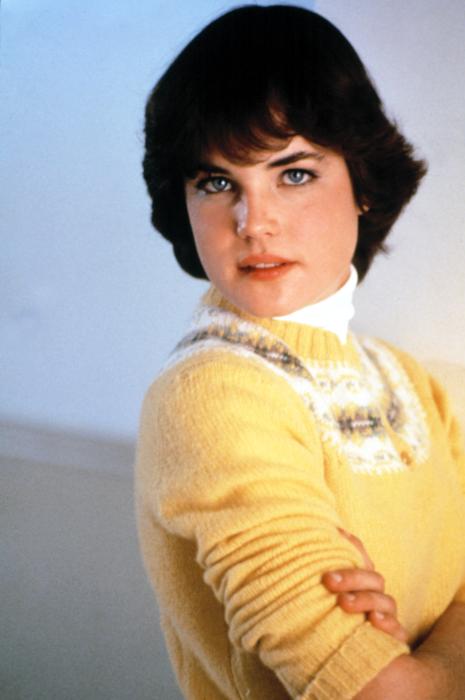
Elizabeth McGovern
Elizabeth McGovern plays a girl from choir whom Conrad is interested in. She's really cute in this movie. I told my students about three different times, "She's the mother in 'Downton Abbey' now," but I don't think they were excited about this as I was.
The last scene of the film is overly sappy--dad and son hugging and crying, so much so I was embarrassed showing that part to my students. Why am I so uncomfortable when men are over-emotional? Maybe that's bad conditioning on my part. Maybe they could just have Calvin say to his son, "We're going to be okay."
Another aspect that makes me uncomfortable about this movie is that the mom, Beth, is such a nightmare. The student beside me said about five times out loud, "She is so scary." Beth is almost as evil as Nurse Ratched in "One Flew Over the Cuckoo's Nest." Both roles are scary to me because I think roles like these can make people seriously hate women, but hopefully that is just me being paranoid.
Alvin Sargent wrote the screenplay for this movie and his name and this movie comes up a lot in books on screenwriting I read. I took a screenwriting course last summer and the scene where the grandparents are taking photos of the family and Beth doesn't want to take a photo alone with Conrad was shown as one of the best examples of subtext.
I've also read that a film like "Ordinary People" would never get greenlit in today's Hollywood. If this is true, I hope this changes because this movie is the type of movie I really enjoy seeing.

